This weekend, one office up for election on the ballot is the spot of NY State Supreme Court Justice for the 5th Judicial District.
Unlike a typical “supreme court” whose job is to review, overturn, or uphold lower court decisions, in NY state that role is filled by the State Court of Appeals. The NY State Supreme Court is actually a criminal/civil court – in fact, the highest trial court in the state.
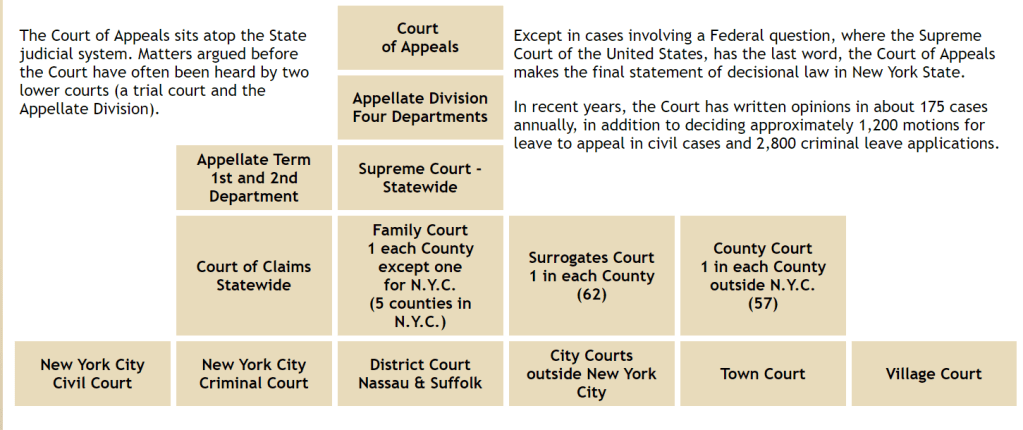
Supreme court justices therefore ‘catch’ all civil cases involving suits whose $ amount exceeds the lower court limits (e.g., over $15,000 in Onondaga County). NY State Supreme court justices also oversee divorces and custody hearings, as well as Article 78 cases – the latter of which is still a little confusing to me. In short, Article 78 is a means to overturn (after the normal appeals process) a ruling by an officer or body – e.g., a restaurant can take an article 78 case to supreme court if they feel their liquor license was rescinded wrongfully based on bad or insufficient evidence. [[This website lists some examples of Article 78 cases.]] Question I’m wondering about: where do police discrimination cases go? Or cases related to officer conduct or violence? Is article 78 the relevant procedure for challenging officer misconduct in NY State? Hmmmm…worth investigating further.
The candidates
There are two candidates running in the 2020 election for 5th Judicial District State Supreme Court Justice: Rory McMahon and Michael F. Young.
Information I found helpful about Rory McMahon:
- McMahon is a sitting City Court Judge in Syracuse. He was elected in 2011 for a 10-year term. Interestingly, in 2011 he accepted endorsements from both Republican and Democratic parties locally.
- McMahon is the presiding judge in the city Opiate Court, which opened in 2019. WAER reviewed the first year of the court’s progress in March 2020.
Information I found helpful about Michael F. Young:
- He is involved in local education in Lewis county, where he lives and works as a district attorney
Worth noting is that campaigning candidates for judicial positions are required to abide by a code of ethics that prohibits making promises or even expressing opinions (Which could be interpreted as commitments/promises) about specific aspects of the law – particularly controversial ones. In other words, a judge’s job is to be an impartial arbiter of existing law, and therefore shouldn’t express partisan opinions about the law itself or its execution.
This means that in judicial elections, an incumbent has a natural advantage given their ability during prior practice to demonstrate their position on the law, its interpretation, enforcement, and procedural problems.
 The Syracuse Voter